Buddhism is the most widely practiced religion in Bhutan. Vajrayana Buddhism is the state religion of Bhutan, and Buddhists comprise 84.3% and Hinduism 11.3% of its population. Although Buddhism practiced in Bhutan originated in Tibetan Buddhism, it differs significantly in its rituals, liturgy, and monastic organization.[3] The state religion has long been supported financially by the government through annual subsidies to Buddhist monasteries, shrines, monks, and nuns.[3] In the modern era, support of the state religion during the reign of Jigme Dorji Wangchuck includes the manufacture of 10,000 gilded bronze images of the Buddha, publication of elegant calligraphic editions of the 108-volume Kangyur (Collection of the Words of the Buddha), and the 225-volume Tengyur (Collection of Commentaries), and the construction of numerous Chorten (stupas) throughout the country. Guaranteed representation in the National Assembly and the Royal Advisory Council, Buddhists constitute the majority of society and are assured an influential voice in public policy.
n 1989 some 1,000 monks (lam, or gelong, novices) belonged to the Central Monastic Body in Thimphu and Punakha, and some 4,000 monks belonged to district monastic bodies. The hierarchy is headed by the Je Khenpo, who was assisted by five lopons or masters, each in charge of religious tradition, liturgy, lexicography, or logic and university. The lonpon, one of whom, the Dorji Lonpon, normally succeeded the current Je Khenpo, had under them religious administrators and junior monastic officials in charge of art, music, and other areas. Gelugpa monks were celibate, but Nyingmapas consist of not only monks but also householders, allowing them to marry, raise families, and work in secular occupations while performing liturgical functions in temples and homes. In all, there were some 12,000 monks in Bhutan in the late 1980s. There were also active congregations of nuns, but no figures were readily available. Most of Bhutan’s Buddhists are adherents of the Drukpa subsect of the Kargyupa (literally, oral transmission) school, one of the four major schools of Tibetan Buddhism.
Since July 2002, Menjong Chöthün Tshogpa, currently a nationwide non-profit organization in Bhutan, has been formed by Truku Jigme Chödrag Rinpoche 70th Kyabje Dorjechang, known as the Supreme Dharma King or His Holiness of Bhutan, mainly to preserve the indigenous Buddha’s Teachings as their age-old culture and tradition. Subsequently Trizin Tsering Rimpoche was enthroned as the chairman by Truku Jigme Chödrag Rinpoche since June 2003.
Later in 2004, Trizin Tsering Rimpoche founded the Buddha Dordenma Image Foundation, under the patronage of Truku Jigme Chödrag Rinpoche, with an aim to fulfill a former prophecy in a terma of Guru Padmasambhava to bestow blessings on world peace and glorious happiness through the currently running Buddha Dordenma Project.
Prior to 1907, the highest Buddhist leader in Bhutan was the Zhabdrung, a tulku who is seen as the reincarnation of Bhutan’s founder. His formal activity to benefit all sentient beings is destined to occur in seven lives, each with his own prophecy.
Buddhist study of cosmology begins with the elemental origins. Space (empty sky) is the mother of all creations. The space that seems empty has all the elements of fire, wind, water and carbon (earth). These elements unite and evolve into forms that are ubiquitous in the universe. Birth culminates in death. The body thus returns to the space. That is a natural law. To simplify the study of this philosophy, colours are assigned as follows:
Colours in Astrology
The characteristics that influence the well-being of human life are called “Kham”. Each of us gets a kham assigned at the time of birth. The elements such as iron, earth, fire, wood and water are associated to khams. These colour expressions are found in Lungta flags and ceremonial scarves. The colours assigned to khams are as follows:
The symbolic arrangement of iron, earth, fire, wood and water means an indestructible luck force. The iron (representation of strength) as a relic in the center is supported by the earth. The earth is protected by fire and wood fuels the fire. Finally water fuels the wood (tree).
Colours in Buddhist Teachings
In Buddhist teachings, there are five emotional roots such as greed, anger, ignorance, pride and jealousy. These five roots give rise to many sub-emotions. Each triggers the display of human consciousness. When these mental arousals go out of balance then negativities arise. When negativities disturb the environment the result is suffering (both for others and self). Therefore roots of emotions go out of control and thus become poisons. Buddhism teaches about taming (putting under control) the five root emotions. The teachings are identified through Buddha expressed in five colours.
Iconography is the study of the identification, description, and interpretation of symbols & themes in visual arts. Iconography developed as an expression, a mode of communication. In Bhutan, iconography study includes scripts, statues, buildings, ritual objects, dances, and paintings. It helps in the documentation of events, ideas, cultures, and in teachings. It is a lifelong study.
The only shortcut to learning it, especially for tourist guides, is by studying the symbolic interpretation. The symbolic interpretation can be studied in the context of myth (the religious approach) or as reality (the contemporary approach).
563 – ca. 483 BC
Siddhartha Gautama lived in the present-day border area between India and Nepal in the 6th century before Christ; his exact birth date is unknown. Because the life of the historical Buddha is inseparable from legend, the following text is not meant to be a historically exact biography, but a short life story based on what has been passed down by generations. The dates are based on present-day historians’ mainstream views.
563 BC – Birth
Siddhartha Gautama is born in Lumbini, near the Nepalese-Indian border to his father, King Suddhodana, ruler of the Sakya tribe, and his mother, Queen Mayadevi. The father gives his son the name of Siddhartha (=the one who obtains success and prosperity), his second name is Gautama (=name of the clan).
Seers predict that Siddhartha will either become a Universal Monarch or a Buddha. Asita, the wisest of the seers, is sure that he will become a Buddha (=one who has supreme knowledge). His mother dies seven days after the birth.
563-547 BC
Siddhartha spends his childhood in the palace of his father at Kapilavastu, Southern Nepal, where he is raised by his aunt Mahaprajapati until the age of seven. In his early childhood, during a plowing ceremony, Siddhartha makes his first unprecedented spiritual experience, where in the course of meditation he develops the first jhana (=meditative absorption) through concentration.
As a young boy he learns the skills of a warrior, including the technical and athletic skills of man-to-man fight. Siddhartha is trained in spiritual disciplines and becomes proficient in the art of archery.
547 BC
At the early age of sixteen, he marries his beautiful cousin Princess Yasodhara, who is of equal age.
547-533 BC
The young prince spends thirteen more years together with his wife in the royal court of his father. Three palaces are built for him, one for the cold season, one for the hot season, and one for the rainy season. Siddhartha enjoys the lavish court life while his father is trying to screen him from all troubles and worries. A son is born while Siddhartha is in his late twenties.
533 BC – The Four Sights
Despite of the amenities of life, Siddhartha is not satisfied with the mere enjoyment of fleeting pleasures due to his inquiring and contemplative nature. One day, he leaves the palace for an excursion and there he encounters what so far has been purposely veiled from him:
He sees a decrepit old man, a diseased person, a corpse being cremated, and a sadhu (=holy man, hermit). Siddhartha realizes that there is old age, sickness, and death and that people ultimately have little control over their lives. The fourth sight provides the inspiration that leads to a dramatic change in his life.
533 BC – The Renunciation
In the night of his 29th birthday, Siddhartha gives up his life as a prince and secretly leaves the court while everyone is asleep. He travels far and crosses the river Anoma, where he shaves his hair and hands over his princely garments to his groom Channa, with instructions to return them to the palace.
533-528 BC
The Bodhisattva (=future Buddha), who once lived in luxury, becomes a penniless and homeless wanderer. He leads a life of self-mortification and spiritual study, becomes first a disciple of several then famous Brahman teachers, and later attracts his own disciples.
After a long and exhausting period of searching and self-mortification, he finally becomes disillusioned with the Indian caste system, Hindu asceticism, and the religious doctrines of his time. He gives up the ascetic life and loses all of his disciples as a result. Nevertheless, he continues his search for truth through the practice of meditation.
April/May 528 BC – Enlightenment
While meditating under a Bodhi tree in Bodh-Gaya, south of Gaya in the state of Bihar, India, the Bodhisattva experiences the Great Enlightenment, which reveals to him the way of salvation from suffering. He spends seven weeks meditating in the vicinity of the site of the Bodhi tree and attains the status of a fully realized Buddha at the age of 35.
June/July 528 BC – First Sermon
Buddha finds his former five disciples in Benares. In his first sermon, he teaches them what will become the gist of Buddhism. Upon hearing it, one of the disciples instantly attains the status of an arhat (=one with enlightened wisdom). This event marks the beginning of Buddhist teaching and his disciples become the first five members of the sangha (=Buddhist order).
528-527 BC
During a short period of time, Buddha establishes a great reputation in western Hindustan by converting thousands of people to the dhamma (=the Buddhist teaching). People hear the dhamma delivered either by himself or by the monks of his order. During this time he delivers the fire sermon.
March 527 BC
The Buddha briefly returns to the palace of his father to convert the royal family and ordains many of the Sakya tribe.
523 BC
Four years later Siddhartha’s father, King Suddhodana, dies. Buddha returns to the palace and Mahaprajapati, where Buddha’s aunt -upon meeting Buddha- becomes the first woman to ordain, despite of the protest of some contemporaries. From this moment on women were admitted to the sangha. According to Indian tradition, however, they were separated and under the authority of male monks.
523-483 BC
In the 45 years following his enlightenment, Buddha travels around Northern India to teach the tenets of Buddhism. He is extremely successful and attracts the first thousand, then ten thousand, and later a hundred thousand people from all walks of life, who voluntarily decide to follow his teachings, the dhamma. During the monsoon, when traveling becomes difficult due to the weather, Buddha and his close followers interrupt their journey. During these months, monks, as well as laypeople, receive the teachings at a site selected for retreat. One such site is Sravasti in Nepal, which has become very famous since then.
Buddha’s success not only attracts admirers but also provokes envy and ill will. Several attempts are made on his life, but all of them fail. Although he is criticized and defamed, this does not affect the popularity of his teaching.
483 BC – Death and Pari-Nirvana
Having achieved the goal of spreading the teaching to the greatest number of people, Buddha dies at the age of eighty years, as a result of food poisoning. He dies in a forest near Kusinagara, Nepal, in the company of his followers reclining on a bed where he speaks his last words: “All compounded things are ephemeral; work diligently on your salvation.” With these words on his lips, he passes into the state of Pari-Nirvana.
To live means to suffer, because the human nature is not perfect and neither is the world we live in. During our lifetime, we inevitably have to endure physical suffering such as pain, sickness, injury, tiredness, old age, and eventually death; and we have to endure psychological suffering like sadness, fear, frustration, disappointment, and depression. Although there are different degrees of suffering and there are also positive experiences in life that we perceive as the opposite of suffering, such as ease, comfort and happiness, life in its totality is imperfect and incomplete, because our world is subject to impermanence. This means we are never able to keep permanently what we strive for, and just as happy moments pass by, we ourselves and our loved ones will pass away one day, too.
The origin of suffering is attachment to transient things and the ignorance thereof. Transient things do not only include the physical objects that surround us, but also ideas, and -in a greater sense- all objects of our perception. Ignorance is the lack of understanding of how our mind is attached to impermanent things. The reasons for suffering are desire, passion, ardour, pursuit of wealth and prestige, striving for fame and popularity, or in short: craving and clinging. Because the objects of our attachment are transient, their loss is inevitable, thus suffering will necessarily follow. Objects of attachment also include the idea of a “self” which is a delusion, because there is no abiding self. What we call “self” is just an imagined entity, and we are merely a part of the ceaseless becoming of the universe.
The cessation of suffering can be attained through nirodha. Nirodha means the unmaking of sensual craving and conceptual attachment. The third noble truth expresses the idea that suffering can be ended by attaining dispassion. Nirodha extinguishes all forms of clinging and attachment. This means that suffering can be overcome through human activity, simply by removing the cause of suffering. Attaining and perfecting dispassion is a process of many levels that ultimately results in the state of Nirvana. Nirvana means freedom from all worries, troubles, complexes, fabrications and ideas. Nirvana is not comprehensible for those who have not attained it.
There is a path to the end of suffering – a gradual path of self-improvement, which is described more detailed in the Eightfold Path. It is the middle way between the two extremes of excessive self-indulgence (hedonism) and excessive self-mortification (asceticism); and it leads to the end of the cycle of rebirth. The latter quality discerns it from other paths which are merely “wandering on the wheel of becoming”, because these do not have a final object. The path to the end of suffering can extend over many lifetimes, throughout which every individual rebirth is subject to karmic conditioning. Craving, ignorance, delusions, and its effects will disappear gradually, as progress is made on the path.
Wisdom
Ethical Conduct
Mental Development
The Noble Eightfold Path describes the way to the end of suffering, as it was laid out by Siddhartha Gautama. It is a practical guideline to ethical and mental development with the goal of freeing the individual from attachments and delusions; and it finally leads to understanding the truth about all things. Together with the Four Noble Truths it constitutes the gist of Buddhism. Great emphasis is put on the practical aspect, because it is only through practice that one can attain a higher level of existence and finally reach Nirvana. The eight aspects of the path are not to be understood as a sequence of single steps, instead they are highly interdependent principles that have to be seen in relationship with each other.
Right view is the beginning and the end of the path, it simply means to see and to understand things as they really are and to realise the Four Noble Truth. As such, right view is the cognitive aspect of wisdom. It means to see things through, to grasp the impermanent and imperfect nature of worldly objects and ideas, and to understand the law of karma and karmic conditioning. Right view is not necessarily an intellectual capacity, just as wisdom is not just a matter of intelligence. Instead, right view is attained, sustained, and enhanced through all capacities of mind. It begins with the intuitive insight that all beings are subject to suffering and it ends with complete understanding of the true nature of all things. Since our view of the world forms our thoughts and our actions, right view yields right thoughts and right actions.
While right view refers to the cognitive aspect of wisdom, right intention refers to the volitional aspect, i.e. the kind of mental energy that controls our actions. Right intention can be described best as commitment to ethical and mental self-improvement. Buddha distinguishes three types of right intentions: 1. the intention of renunciation, which means resistance to the pull of desire, 2. the intention of good will, meaning resistance to feelings of anger and aversion, and 3. the intention of harmlessness, meaning not to think or act cruelly, violently, or aggressively, and to develop compassion.
Right speech is the first principle of ethical conduct in the eightfold path. Ethical conduct is viewed as a guideline to moral discipline, which supports the other principles of the path. This aspect is not self-sufficient, however, essential, because mental purification can only be achieved through the cultivation of ethical conduct. The importance of speech in the context of Buddhist ethics is obvious: words can break or save lives, make enemies or friends, start war or create peace. Buddha explained right speech as follows: 1. to abstain from false speech, especially not to tell deliberate lies and not to speak deceitfully, 2. to abstain from slanderous speech and not to use words maliciously against others, 3. to abstain from harsh words that offend or hurt others, and 4. to abstain from idle chatter that lacks purpose or depth. Positively phrased, this means to tell the truth, to speak friendly, warm, and gently and to talk only when necessary.
The second ethical principle, right action, involves the body as natural means of expression, as it refers to deeds that involve bodily actions. Unwholesome actions lead to unsound states of mind, while wholesome actions lead to sound states of mind. Again, the principle is explained in terms of abstinence: right action means 1. to abstain from harming sentient beings, especially to abstain from taking life (including suicide) and doing harm intentionally or delinquently, 2. to abstain from taking what is not given, which includes stealing, robbery, fraud, deceitfulness, and dishonesty, and 3. to abstain from sexual misconduct. Positively formulated, right action means to act kindly and compassionately, to be honest, to respect the belongings of others, and to keep sexual relationships harmless to others. Further details regarding the concrete meaning of right action can be found in the Precepts.
Right livelihood means that one should earn one’s living in a righteous way and that wealth should be gained legally and peacefully. The Buddha mentions four specific activities that harm other beings and that one should avoid for this reason: 1. dealing in weapons, 2. dealing in living beings (including raising animals for slaughter as well as slave trade and prostitution), 3. working in meat production and butchery, and 4. selling intoxicants and poisons, such as alcohol and drugs. Furthermore any other occupation that would violate the principles of right speech and right action should be avoided.
Right effort can be seen as a prerequisite for the other principles of the path. Without effort, which is in itself an act of will, nothing can be achieved, whereas misguided effort distracts the mind from its task, and confusion will be the consequence. Mental energy is the force behind right effort; it can occur in either wholesome or unwholesome states. The same type of energy that fuels desire, envy, aggression, and violence can on the other side fuel self-discipline, honesty, benevolence, and kindness. Right effort is detailed in four types of endeavours that rank in ascending order of perfection: 1. to prevent the arising of unarisen unwholesome states, 2. to abandon unwholesome states that have already arisen, 3. to arouse wholesome states that have not yet arisen, and 4. to maintain and perfect wholesome states already arisen.
Right mindfulness is the controlled and perfected faculty of cognition. It is the mental ability to see things as they are, with clear consciousness. Usually, the cognitive process begins with an impression induced by perception, or by a thought, but then it does not stay with the mere impression. Instead, we almost always conceptualise sense impressions and thoughts immediately. We interpret them and set them in relation to other thoughts and experiences, which naturally go beyond the facticity of the original impression. The mind then posits concepts, joins concepts into constructs, and weaves those constructs into complex interpretative schemes. All this happens only half consciously, and as a result we often see things obscured. Right mindfulness is anchored in clear perception and it penetrates impressions without getting carried away. Right mindfulness enables us to be aware of the process of conceptualisation in a way that we actively observe and control the way our thoughts go. Buddha accounted for this as the four foundations of mindfulness: 1. contemplation of the body, 2. contemplation of feeling (repulsive, attractive, or neutral), 3. contemplation of the state of mind, and 4. contemplation of the phenomena.
The eighth principle of the path, right concentration, refers to the development of a mental force that occurs in natural consciousness, although at a relatively low level of intensity, namely concentration. Concentration in this context is described as one-pointedness of mind, meaning a state where all mental faculties are unified and directed onto one particular object. Right concentration for the purpose of the eightfold path meanswholesome concentration, i.e. concentration on wholesome thoughts and actions. The Buddhist method of choice to develop right concentration is through the practice of meditation. The meditating mind focuses on a selected object. It first directs itself onto it, then sustains concentration, and finally intensifies concentration step by step. Through this practice it becomes natural to apply elevated levels concentration also in everyday situations.

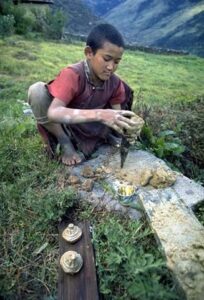
Tsatsa, with its origin in Sanskrit, is a typical Tibetan Buddhist art form. Actually tsatsas are votive tablets in Buddhism, usually clay impressions made with a metal mould containing hollowed, reversed image of a deity, a stupa or other sacred symbols. Tibetan people believe that making tsatsas is a merit accumulating action. As holy objects, tsatsas can be found inside stupas, prayer wheel niches, holy caves and monastery altars or beside holy mountains, holy lakes and other holy sites. Small tsatsas can be put inside a portable amulet shrine and taken as amulets by those traveling. Making tsatsa is a compulsory skill of monks in Tibetan monasteries.
Tsatsas fall into different categories in accordance with ingredients added, including plain clay tsatsa, which has no special ingredient; ash tsatsa, which has ashes of late lamas added; medicine tsatsa, which has Tibetan herbs added; humoral tsatsa, which contains liquid produced in the mummifying procedure of late high lamas; and tsatsa made by high lamas themselves or other celebrities. In addition, however, there are some virtual tsatsas made. Lucky travelers may find in some region that Bhutanese are using their tsatsa
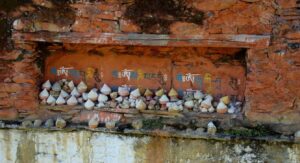
Any traveller who ventures today into a monastery area where Buddhism is practicethe Bhutan is certain to come across examples of clay tablets deposited within stupas, holy caves, and monastery altars. These clay tablets are generally known as tsa-tsa; a name which Tucci traces back to Sanskrit.
Tsa-tsa are clay impressions made with a metal mould containing the hollowed, reversed image of a deity or sacred symbol. The stamped images are dried in the sun and in some cases fired into hardness.
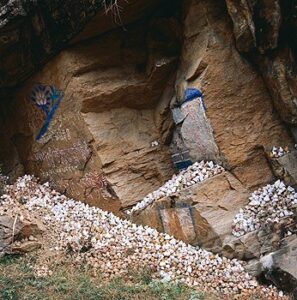
Especially large tsa-tsa are sometimes colored and varnished and may be empowered by inserting a roll of prayers or mantras in a hollow space at the base. They may be empowered also by printing or writing a mantra on the back . Thereafter the tsa-tsa is treated no differently from other sacred images. Through auspicious action ordinary clay becomes transformed into a receptacle for sacred power.Tsa-tsa are sometimes produced in connection with a pilgrimage to sacred places. A traveller carries the metal mould and, upon reaching a sacred site, collects holy clay to stamp images. Reciting mantras all the time as the clay is kneaded, a number of tsa-tsa would be produced to either leave behind as offerings or bring back home as relics.
Tsa-tsa produced with sacred clay are also carried home as most precious relics. These are either placed on the home or monastery altar or given away as pilgrimage gifts connecting the recipient with the distant sacred sites. Sometimes pilgrims, after years of following the sacred routes, accumulate a good number of small tsa-tsa from all the places visited. In order to preserve them well the small clay medallions are imbedded in a wood board and a portable altar made out of them.

Anything which carries a representation of a deity is considered a sacred object, specially if it has been ritually empowered by a great teacher or came from a holy place. So tsa-tsa are sometimes placed within statues as part of the empowerment.
Tsa-tsa also play a very important role in funeral practices. Usually after a person passes away a ceremony is performed for 49 days or less in front of an effigy of the deceased. The effigy may be as simple as a woodblock print together with some personal item. A lama reads everyday from sacred texts guiding the consciousness of the departed through the itinerary of the intermediate dimensions called the Bardo. At the conclusion of the readings the paper print representing the deceased is burned in a final ceremony. The ashes from the print are then mixed with clay and a number of tsa-tsa stamped by a relative or close friend. These funeral tsa-tsa are almost always shaped as conical stupas of a very ancient design . While the clay is still soft inside the metal mould a few grains of either barley or wheat are inserted. Since funeral tsa-tsa are rarely fired, the grains sometimes sprout bringing to life the tiny stupas.
As the tsa-tsa dry they are placed in piles within the core of the open stupa. Once stupais full the door of access is sealed up and a lama may then perform a consecration