M3 Adventures

Culture & Religion

Bhutan’s national flag is a white dragon on a diagonally divided of golden yellow and reddish orange. The yellow represents the secular power of the king, the orange the Buddhist religion. The white of the dragon is associated with purity, and the jewels held in the claws stand for the wealth and perfection of the country. The national emblem is composed of double diamond thundervolt placed above a lotus, surmounted by a jewel expresses sovereign power and the two dragons, male and female stand for the name of the country Drukyul the land of the thunder dragon.

Bhutan is the only country to maintain Mahayana Buddhism in its Tantric Vajrayana form as the official religion. The main practicing schools are the state sponsored Drukpa Kagyupa and the Nyingmapa Buddhism transects all strata  of society underpinning multiple aspects of the culture. Indeed religion is the focal point for the arts, festivals and tulkus( reincarnation of high lamas) is indicative of the overarching role religion plays throughout the nation.

Although the Zhabdrung is regarded as the founder of the nation, the secular realm has achieved an unprecedented degree of unity under the influential guidance of a Twentieth century monarchy. Within a cultural context where the spiritual and temporal spheres are intimately connected, political leadership remains interpreted as divinely determined. The royal family traces its roots to the great sixteenth century saint Pema Lingpa and the present monarch still enjoys a god – like status throughout much of his kingdom., with the throne retaining its position as the political system.

Bhutanese art possesses a major Tibetan influence, although it has developed some of its own derivations. It has three main characteristic: it is anonymous religious and performs no independent aesthetic function. Intricate wall paintings and thankas ( wall hangings) most historical writings and fine sculpted  images all have a religious theme. Given their role, these may be interpreted as created by artisans rather than artists, although there exist many extremely fine examples. All are viewed as sacred and newly commissioned paintings and sculptures are consecrated through a special ceremony whereby they come to personify the respective deities.

Although both Buddhism and the monarchy are critical elements, it is the general extensive perpetuation of tradition that is possibly the most striking aspects of Bhutan’s culture. This is most overtly reflected in the nature of dress and architecture. All Bhutanese continue to wear the traditional dress: for men and boys the gho, a long gown hitched up to the knees so that its lower half resembles a skirt, for women and girls the kira, an ankle length robe some what resembling a kimono. Generally colorful apparel, the fabric used range from simple cotton checks and stripes to the most intricate designs in woven silk.

The Bhutanese srchitectural landscape is made up of chortens, stonewalls, temples, monasteries, fortresses,mansions and houses. Associated with a number of clear-cut architectural concepts and building types rooted in Tibetan Buddhism, there is a strong association between state, religious and secular forms. What makes it quite unique is the degree of uniformity, with all structures corresponding to traditional designs. Thus ancient monasteries  and fortresses appear to merge with more modern popular dellings to create a setting that is fully internally consistent.

Buddha Dordenma

 The 169-feet bronze statue of Buddha Dordenma, Vajra Throne Buddha, symbolising indestructibility, and seated on a vajra throne built  at Kuensel Phodrang in Changbangdu, overlooking the capital city .It  is the tallest Buddha Dordenma in the world .

Now in ruins, Kuensel Phodrang was once the palace of the 13th Desi Sherab Wangchuk. It is located some 100 meters above Thimchu on a slope.

Approved by His Majesty the King and the government, the Buddha Dordenma project is being initiated by the chairman of Menjong Chhothuen Tshogpa, Lam Tshering Wangdi, to commemorate the hundred years of monarchy in 2007.The Buddha statue will overlook the capital city. Within the gigantic bronze structure including the thri (throne) there will be enough space to house 17 storeys of different lhakhangs.

These include three storeys within the throne, two each inside the lotus, waist, chest, face and shoulder and one each in the legs, neck and head.

In the first two storeys, which are both 15 feet high there will be 25,000 images of 12-inch Buddha Dordenma. “Made of copper and gilded in gold they will be displayed around the walls of the meditation hall inside the throne,” Lam Tshering Wangdi told Kuensel. “The names of the individual sponsors of the statues will be engraved on copper-plate with powder coating.”

The first storey, which surrounds the centre, will house eight 10-feet standing bodhisattvas, the miracle sons of Buddha Shakyamuni.

The second storey surrounding the centre pillar will have eight more 10-feet sitting Medicinal Buddhas.

The third storey inside the lotus seat will house six-feet high 16 arahats, King Hashang (Maitreya Bodhisattva), Dharmata Tiger, Sutra Holder and the four direction kings. In the centre chamber will be seated the main Buddha Shakyamuni.

The rooms from the third storey till the top will accommodate 100,000 statues of eight-inch Buddha Dordenma made of copper and gilded in gold placed in multi-layered grid-boxes. “We will accept donations from interested individuals for these eight-inch statues as well,” said Lam Tshering Wangdi. “The names of the donors will be inscribed separately on copper-plates, and displayed in the meditation hall.”

The Bhutanese master sculptors had built a 12-meter high model statue of the Buddha and given it to a Chinese company, Aerosun Corporation in Nanjing, China. The work on the bronze statue began towards the end of 2004.

To make sure that the statue is given a Bhutanese look, the master sculptors who made the model frequently visited China before it was completed

The contract was given to the Aerosun Corporation for US$ 20 million, which includes shipping the 600-tonne statue to Bhutan after its completion in 2007 and assembling it at Kuensel Phodrang.

Another 10 acres of land will be required to build public galleries, restaurants, large parking spaces, camping grounds, dharamsalas and quarters for monks.

Lam Tshering Wangdi told Kuensel that before the contract was handed over to the Chinese company, the proposal was taken to other Asian countries like India, Nepal, Myanmar, Thailand and Indonesia.

“But they all declined the offer stating that it was too big a structure and would be impossible to complete it within three years,” said Lam Tshering.

Lam Tshering later heard of a similar bronze statue of about 86 feet built in Nanjing by the same Chinese company. The company was a major manufacturer of bronze and copper, which are ideal and cheap material to build statues.

The company further reduced the cost of building the statue by US$ 5.0 million, according to Lam Tshering Wangdi.

The statue is expected to be a major pilgrimage centre and a focal point for Buddhists all over the world to converge, practice, meditate and retreat.

“It is also meant to fulfill the prophecy of bestowing blessings, universal peace and happiness to the world as a whole,” Lam Tshering Wangdi told Kuensel. “I have taken this initiative in accordance with Lam Sonam Zangpo’s prophecy, a renowned yogi, who said that construction of a statue either of Guru, Buddha or Phurba in this region would bring stability, peace and prosperity in the country.”

A Singaporean businessman, Rinchen Peter Teo, is the main sponsor of the project.

Choetens or Stupas

108 Bhutanese Style Stupas at Dochula Pass 3150meters above sea level, Thimphu – Punakha national high way.

The Bhutanese word is Chorten, which means “the basis of offering”.

It is a symbol of enlightened mind, (the awakened mind, universal divinity) and the path to its realisation.

If you had to use just two words, the best definition I have seen is “Spiritual Monument”

The stupa represents the Buddha’s body, his speech and his mind, but most especially his mind and every part shows the path to Enlightenment

“The visual impact of the stupa on the observer brings a direct experience of inherent wakefulness and dignity. Stupas continue to be built because of their ability to liberate one simply upon seeing their structure” – Chogyam Trungpa Rinpoche

Every stupa contains at the very least a life tree and holy relics:

“When a great teacher passes away, his body is no more, but to indicate that his mind is dwelling forever in an unchanging way in the dharmakaya, one will erect a stupa as a symbol of the mind of the buddhas” – HH Dilgo Khyentse Rinpoche

The Nepali-Style Chorten is based on the classical stupa. On the Nepali chorten, sides of the tower are painted with pair of eyes, the all-seeing eye of Buddha. What appears to a nose is actually the Sanskrit character for the number one, symbolizing the absolute ness of Buddha. The large Chortenkora in Trashi Yangtse and Chendebji chorten near Trongsa are two examples of this style.

The Tibetan-Style Chorten has a shape similar to a stupa, but the rounded part flares outward instead of being a dome shape. National Memorial chorten in Thimphu is an excellent example of this style.

The Bhutanese Design comprises a square stone pillar with khemar near the top. The exact origin of this style is not known, but is believed to be a reduced form of the classical stupa, with only the pinnacle and square base. Some Bhutanese chorten have a ball and crescent representing the moon and the sun on the top.

National Memorial Choeten (Seat of Faith)

An important historical landmark in the Thimphu city, the National Memorial Chhorten was constructed in 1974, In memory of the third king Jigme Dorji Wang chuck, who died in 1972.   The Chorten has great significance in the religious life of the people and symbolizes, as do all stupas, the levels of the Buddha’s mind and teachings; inside the chhorten we can see Kar-Gong-Phur-Sum. It is ritually circumambulated clockwise to gain merit for the next life and atone for present sins, considering it one of the most magnificent of all contemporary Tibetan or Bhutanese style monuments.

The Chhorten contains three chapels representing the main spiritual themes of the Nyingmapa School, preached by Guru Rinpochha. The three storeys contain enormous three-dimensional Mandalas of meditational deities. The painting and sculpture of religious figure can be seen inside the chhorten. Occasionally a religious ceremony is performed here. 

Prayer Flags

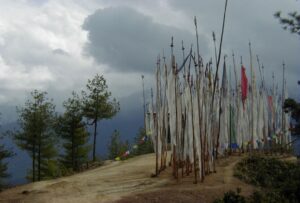
Prayer flags on poles, on trees, and on bridges are a common sight everywhere in Bhutan today symbolizing the ever flourishing Buddhism and ever growing faith of the people. Bhutan being a Buddhism country prayer flags has been part of Bhutanese people’s    tradition, symbolizing the reality and religious belief.

So we can see every where top on the hills, down the valley, across the rivers and

along the road side with different colors of flag hung from one end to another or fixed on the wooden poles vertically, on the wooden poles we can see the on the top most is Raldi (dagger) which signifies the god of wisdom (god of knowledge), A wheel or Khorlo at the base of the dagger signifies the wheel of dharma. The flagpole, which is made smooth and white by removing the bark, signifies Chenrigzee (Avaloktisvera), the compassionate. The base of the pole is usually kept thicker and stronger signifying Chagna Dorji, (Thunderbolt).  Flag contain of five different colors called Dar Nge-Nga (five different colures) Kar –    (white) Sheer (yellow) Mar (red) Jang (green) Rue (blue)
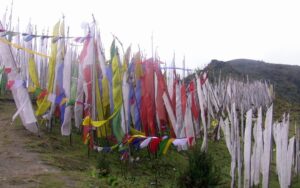
GREEN:   Vegetation

BLUE:         Sky

WHITE:   Clouds

YELLOW: Earth

RED: Wind

Some of the symbols of different colors according to Buddhism
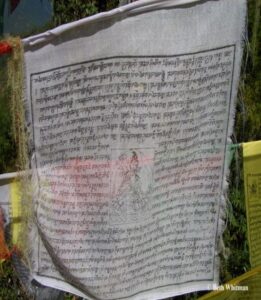
Kar (white):

White is not really a color. It occurs when the whole spectrum of light is seen together or when red, yellow and blue colors are mixed. Everything is present in white; nothing is hidden, secret or undifferentiated.

Goddess Tara in which grants longevity to worshippers is depicted as white hued (White Tara). She also denotes purity, holiness and cleanliness and is ‘the one who leads out beyond the darkness of bondage’. White is a color that both incorporates, and set things apart from the rainbow spectrum of everyday life.

The color white appears in numerous Buddhist episodes, one of the most well known being the birth of Buddha. Legend states that Queen Maya, mother of Buddha dreamt of a white elephant that flew through the air and touched the armed.
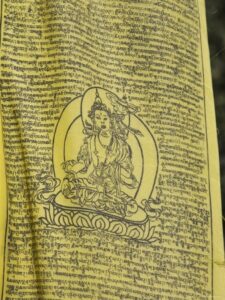
Sheer (Yellow):

Yellow has highest symbolic value in Buddhism through its link with the saffron robes of monk. This colors previously worn by criminals’, was chosen by Gautama Buddha as a symbol of his humility and separation from materialist society. It thus signifies renunciation, desirlessness, and humility.

Yellow colors are the colors of earth, and thus a symbol of rootedness and the equanimity of the earth.
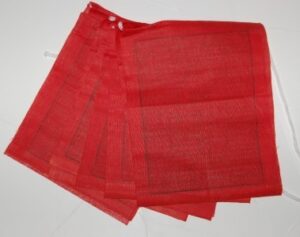
Mar (red):

The color red is auspicious in Buddhist culture. It is a sacred color, one of the colors of the five Buddha’s and the color of the monk’s garments. It is believed to have protective qualities and is therefore often used to paint sacred buildings and temples.

 Red is the color of powerful rituals and deeds. It is the color of passion, transmuted to discriminating wisdom. These are especially relevant in especially vigorous meditation rituals requiring equally potent meditative tools.

.
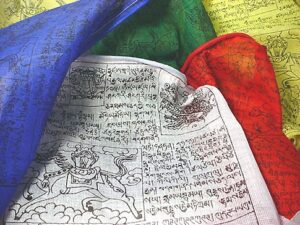
Jang (green):

Green is in the middle of the visible, seven-color spectrum and thus epitomizes the qualities of balance and harmony. It is the color we relate to in nature, trees and plants. Hence Green Tara‘s color represents a blending of white, yellow, and blue – colors which symbolize, respectively, the functions of pacifying, increasing, and destroying.

Green also denotes youthful vigor and activity, and the Green Tara is always shown as a young girl having a mischievous and playful nature. The Buddhist Lord of karma (action), Amoghasiddhi, is also associated with this color, reiterating that green in Buddhist thought is the color of action.
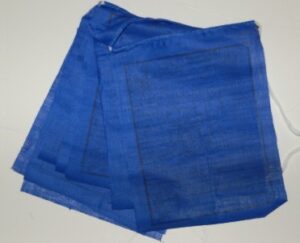
Rue (blue):

 ‘Blue Buddha’, also known as the Buddha of Medicine or Healing. The most distinctive feature of this Medicine Buddha is his color

Indeed to this day, statues prepared in Tibet and the Himalayan kingdom of Bhutan has their hair painted blue.

Traditionally this beautiful stone was used to symbolize that which is pure or rare. It is said to have a curative or strengthening effect on those who wear it, and its natural smoothness allows it to be polished to a high degree of reflectivity.  For all these reasons, plus the fact that deep blue light has a demonstrable healing effect on those who use it in visualization practices, lapis is the color of the principal Medicine Buddha, making this stone an important one in Buddhist mysticism.
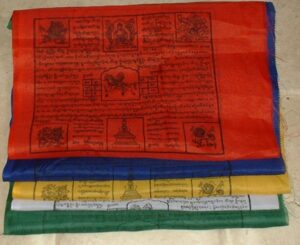
  Lungdar / Lung-Ta Wind Horse (luck):

Pray flags are inscribed with auspicious symbols, invocations, prays, Nags, (mantras) prints of Buddhist protectors and enlightened beings. These prays flag brings good luck and merit to all sentient beings

There are several types of Lung –dar and we called it Tak-Sing-Chung-Druk (Tiger-lion-Garuda-Dragon) with five different colors are used depending on element (fire, water, wood, iron).

Lungdhar or Lung Ta, meaning, “Wind Horse”are raised or hung on the advice of an astrologer to dispel misfortune, or on the onset of a long journey, and more recently while starting a new venture.
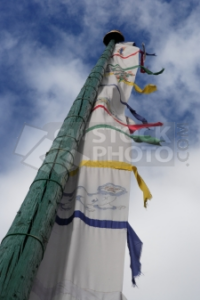
           

 Lhadar:

 Lhadhar is also a form of Lungdhar, but is much taller and larger. Usually a Gyeltshen (victory sign) caps the top.

The Lhadhar is hoisted as a landmark near dzong and lhakhang. “When you see this flag, it is a sign that you have come near a dzong or lhakhang. It is a sign for you to be formally ready.
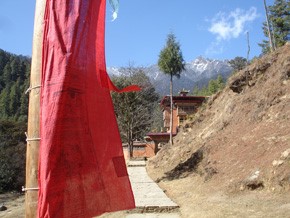
Gyeltshen Tsemo:

Mantras are printed on the different colors. It was also raised by dzongpon and rich and powerful families in the past to bring success in their undertakings and to drive away the evil fate and obstacles in life. Prayer flags are traditionally fastened to wooden poles vertically or sewn on to ropes horizontally
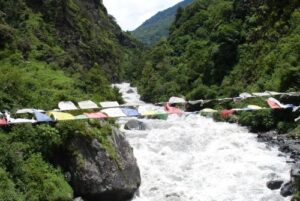
Chudar:

In case of Chudar pray flags are sewn on to the ropes horizontally from one end of river side to other side or over the bridge. Yellow, green, red, white and blue colors are used in chudar depending on the element (fire, water, wood and earth) one belongs to.

Generally, in Bhutan, prayer flags are hoisted for happiness, long life, prosperity, luck and merit and to offer karmic merit to all sentient beings. After one dies, the benefits offering prayer flags is believed to guide the soul of the dead away from the netherworld and to prevent it from being reborn in the three lower realms.

Prayer flags are raised outside homes, hung on bridges, hilltops, and places of spiritual importance. According to the scholar, there are generally three types of printed prayer flags: