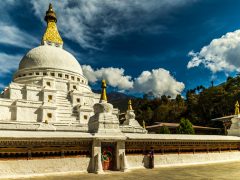
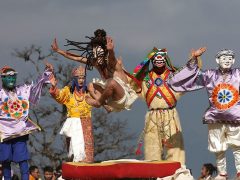
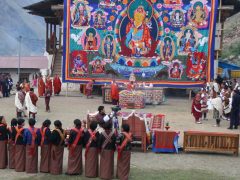
Paro Tshechu is a 5 day event held annually at the Paro Dzong and Dzongdrakha monastery above Bondey. It is held annually from the 11th to the 15th of the 2nd Bhutanese month since its inception in the mid-17th century.
Two elements that set Paro Tshechu apart from the other tshechu festivals are the cymbal terma (treasure) and the second is world’s largest embroidered thongdrol (appliqué) of Guru Padmasambhava. These two objects are considered national treasures and are revealed only once a year during the Paro Tsechu.
The cymbal was revealed from the lake Nubtsonag Patra in Haa Valley and has been housed inside the Paro Dzong since its discovery in the 13th century. The scared cymbal is displayed once a year on the first day of the Paro tsechu accompanied by a black hat dance inside the dzong courtyard. It is believed that the mere sound of the cymbal is enough to ward off obstacles, and bad Karma and liberate beings from suffering.
The thongdrol was commissioned and created by enlightened Bhutanese masters around the 17th century. At eighty five feet wide and fifty-five feet tall and weighing about a thousand pounds, the thongdrol is unfurled once a year on the last day of the Paro Tsechu coinciding with the full moon. The procession begins inside the dzong at 3 a.m. and involves numerous preparations for handling and transporting it. It takes about 45 minutes for the thongdrol to be transported to the nearby ground in the pre-dawn darkness. After much maneuvering and careful unrolling; the thongdrol is hung from the tower for all to see. The thongdrol is rolled back up before the sun has fully risen and returned to the dzong in another grand procession where it is safely stored until the next year. Devotees who arrive as early as 2 a.m. line up to receive blessings from the thongdrol during the processions and also when the thongdrol is displayed.
Day 1:
Begins around 9 am and ends around 3:30 pm. Events are conducted inside the courtyard of Paro Rinpung Dzong.
- Regional governor, judges and public representatives line up in ceremonial procession to welcome and escort the head lama of Paro Dzong to this sitting place.
- Followed by a cymbal dance performed in the courtyard. Ritual instruments such as cymbals, drums, conch shells are played for this dance. The sacred cymbal is displayed between 10 to 11 am.
- Welcome song by district singers.
- Shinje Yab-Yum (Yamantaka Yab-Yum Dance- dance of the lord of death and his consort) performed by monks.
- Song of Woochu Village by district singers.
- Durdag Cham (Lord of cremation ground dance) performed by monks.
- Zhanag Cham (Black hat dance) performed by monks.
- Zhungdra (traditional song) sung by district singers.
- Dramestse Nga Cham (Drum dance of Drametse) performed by laity.
- Lunch offering ceremony by the Atsara (clown).
- Boedra (folk song) performed by district singers.
- Degyed Cham (Eight groups of deities dance) performed by laity.
- Song of Woochu Village performed by district singers.
- Song of Dranyen Chozhey by dzongkhag singers.
Boedra (folk song) by district singers
(This day is not a Govt. holiday)
Day 2:
Begins with an inauguration at the Dheyankha ground around 9 am and ends in the afternoon. Dheyankha ground is an open-air courtyard located next to the Paro Dzong.
- Chibdrel ceremony for the lam of the Dzong is performed. Chibdrel ceremonies honor the chief guest and monks.
- Dance of the Lord of Death and his consort (Shinje Yab Yum)
- Dance of the Black Hats with Drums (Shanag Nga Cham)
- Song from Woochu village performed by laity.
- Dance of the 3 kings of Ging with Sticks
- Welcome dance by district singers.
- Dance of the Lords of Cremation Grounds (Durdag)
- Zhungdra (traditional song) performed by district singers.
- Dance of the Evil Sprity Nyulema, peformed by laity.
- Juging Cham (Stick dance) perfomed by laity.
- Folk song by district singers.
- Durdag Cham (Lord of cremation ground dance) performed by laity.
- Driging Cham (Sword dance) performed by laity.
- Folk song by district singers.
- Nga Ging Cham (Drum dance) performed by laity
- Zhungdra (traditional song) performed by district singers.
- Divination by Atsara (clown).
- Folk songs by district singers.
Day 3:
Begins with an inauguration at the Dheyankha ground around 9 am and ends in the afternoon at about 4pm. Dheyankha ground is an open air courtyard located next to the Paro Dzong.
- Chibdrel procession ceremony for Lam of Dzong and monks, constituted of the governor, judges and representatives gathered in the dzong to proceed to Dheyangkha.
- Folk song from Woochu village by district singers
- Durdag cham (Lord of cremation ground dance) by monks.
- Folk song by district singers.
- Tum Ngam Cham (Guru’s wrathful dance) performed by monks.
- Gyen Druk Cham (Six ornaments dance) performed by monks.
- Zhungdra (traditional song) by district singers.
- Pholay Moley Cham (The dance of charming ladies and noblemen) performed by laity.
- Folk song of Woochu village by district singers.
- Dance of the Stag and Hound, performed by laity.
- Dance of Acho Phento and Lama Rechungpa, performed by laity.
- Dance of offering ceremony to Mahakala, performed by Atsara.
- Folk song by district singers.
Day 4:
Begins with an inauguration at the Dheyankha ground around 9 am and ends in the afternoon at about 3pm. Dheyankha ground is an open air courtyard located next to the Paro Dzong.
- Chibdrel procession ceremony.
- Folk song of Woochu village by district singers.
- Sinje Yabyum Cham by monks.
- Shazam Cham (Stag Dance) performed by laity.
- Bardo Cham (Bardo dance) performed by laity.
- Atsara Go Cham (initial dance of Atsara) performed by laity.
- Zhungdra (traditional song) performed by district singers.
- Folk song of Woochu village by local singers.
- Drameste Ngacham (Drum dance from Drametse) by laity.
Day 5:
Begins with the Thongdrol procession at 3 am, then the unfurling at dawn, and the thongdrol is rolled back at about 8 am.
Then follows:
- Jipai Pawo Dance (Dance of the Heroic Youth), performed by two lay men.
- Atsara Dance of Tshoman performed by laity.
- Cymbal Dance, performed by monks while Atsara is imitating child birth.
- Heroic Dance performed by laity.
- Traditional song by district singers.
- Tshog Ling Dance of Wrathful Deities performed by monks
- Ging Dance performed by laity wearing skeleton masks.
- Folk song by district singers
- Guru Tsengye- Dance of Eight Manifestations of Guru Padmasambhava
- Traditional song by district singers
- Sixteen Dakinis Dance with hand Drum and Stick performed by monks
- Sixteen Dakinis Dance with Damaru and Bell performed by monks.
- Dance of Chozhey (Dharma song) performed by laity
- Song of Trashi Legpel: This defines the completion of Paro Tshechu.
Note: The dances and timings in the program may not necessarily be in order and are subject to change; they have been provided as a general guideline.