Punakha is located in the western part of Bhutan is the winter home of the Je Khenpo, the Chief Abbot of Bhutan. Punakha has been of critical importance since the time of Zhabdrung Ngawang Namgyel in 17th century.
Zhabdrung Ngawang Namgyal is known as the unifier of Bhutan as a nation state and he was the one who gave Bhutan and its people the distinct cultural identity that identified Bhutan from the rest of the world.
During 17th century Bhutan was invaded several times by Tibetan forces seeking to seize a very precious relic, the Ranjung Kharsapani. Zhabdrung Ngawang Namgyal led the Bhutanese to victory over the Tibetans and to commemorate the triumph he introduced the Punakha Drubchen. Since then Punakha Drubchen (also known as Puna Drubchen) became the annual festival of Punakha Dzongkhag.
The Punakha Drubchen is a unique festival because it hosts a dramatic recreation of the scene from the 17th century battle with Tibetan army. The ‘pazaps’ or local militia men dress in traditional battle gear and reenact the ancient battle scene. This reenactment harkens back to the time when in the absence of a standing army, men from the eight Tshogchens or great village blocks of Thimphu came forward and managed to expel the invading forces from the country. Their victory ushered in a period of new-found internal peace and stability.
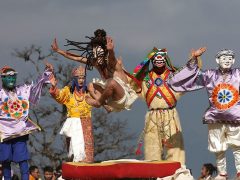
The 5 day Drubchen is held from the 5th to the 9th of the 1st Bhutanese month. All days of the festival have mask dances, folk songs, and other traditional dances. The first and second day dances are held inside the sacred Dukhang (photography is not allowed). The third day dances are held in the open courtyard, the fourth day is rest day. The fifth day has the Serda procession and recreation of the battle together with other dances and this is the highlight of the Punakha Drubchen.
Punakha Tsechu
In 2005, another festival known as Punakha Tshechu was introduced by the 70th Je Khenpo Trulku Jigme Choedra and the then Home Minister His Excellency Lyonpo Jigme Yoedzer Thinley. The Tshechu was introduced in response to the requests made by Punakha District Administration and local people to host a Tshechu in order to better preserve Buddhist teachings and keep alive the noble deeds of Zhabdrung Rimpoche. A series of colorful and spectacular mask dances are performed. The Punakha Tsechu takes places immediately after the conclusion of the Punakha Drubchen.
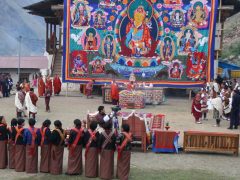
The 3 day tsechu is held from the 10th to the 13th of the 1st Bhutanese month. All three days of the festival have mask dances, folk songs, and other traditional dances that take place in the open courtyard of the Punakha Dzong. The highlight of the Punakha Tsechu is the display of a thongdrol (appliqué) on the morning of the first day. The 83 feet by 93 feet thongdrol pays homepage to Zhabdrung Ngawang Namgyal (unifier of Bhutan). It is composed on 6000 meters of silk brocade crafted by 51 artists over the course of two years.
Note: The dances and timings in the program may not necessarily be in order and are subject to change; they have been provided as a general guideline.