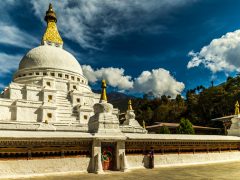
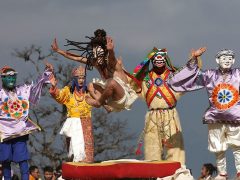
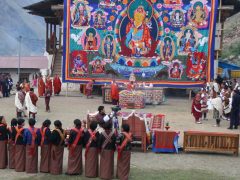
Thimphu Drupchen also known as Lhamo Drupchen is a 2 week ritual performed by monks to appease the only female dharma protector Pelden Lhamo. Each morning monks gather at 3 a.m. in front of Pelden Lhamo’s shrine and perform prayers to promote happiness, longevity, and peace towards all beings. The prayers are accompanied by the Black Hat Dance every morning inside the main chapel of Tashichho Dzong to honor Pelden Lhamo and to eliminate evil forces. Tourists are not allowed to view these events and women cannot enter the shrine of Pelden Lhamo (inside the Dzong).
After the completion of the 2 week ritual, follows the three day Thimphu Drupchen which showcases the deity Pelden Lhamo and her manifestations for the public to view. Monks perform the dances during the Thimphu Drupchen and hence it is considered very sacred by the locals. Thimphu Drupchen takes place in the inner open courtyard of the Tashichho Dzong.
Day 1: starts at 10 am
*Black Hat Dance (Shanag)
*Dance of Kasung Nyokha Yab-Yum:
(*Lord of Cremation Ground Dance (Durdag)
*Palden Lhamo Dance
Day 3:
*Lord of Cremation Ground Dance (Durdag)
*Assembly Dance of Protective Deities
Thimphu Tsechu
Following the Thimphu Drupchen, the four day Thimphu Tsechu begins on the 9th till the 12th of the 8th Bhutanese month. Like all tsechus, the Thimphu Tsechu is not a festival put on for entertainment but it is a series of scared events with the ultimate Buddhist intent to develop an enlightened mind in the attendees. From the year of its establishment in 1687 until 2007, Thimphu Tsechu was performed in the inner open courtyard of the Tashichho Dzong. With the increase in attendees, a new tsechu stadium was constructed as an extension to the Tashichho Dzong. The new open air stadium named “Tendrel Thang” (Auspicious Ground) was built to coincide with the coronation of the Fifth King in 2008. Since then, the Thimphu Tsechu has been performed at the Tendrel Thang at Tashichho Dzong.
Day 1: All sacred dances on this day are of the bod cham category, meaning the ordinary people perform them (not monks).
Folk song
Four Stag Dance (Shacham)
Folk song
The Dance of the Three Kinds of Ging (Peling Ging Cum)
Folk song
Dance of the Heroes (Pacham)
Folk song
Stag and Hounds Dance (Shawo Shachhi)
Folk song
Dance of Dranyen (Guitar)
Day 2
Folk song
Black Hat Dance (Shana): Performed by monks
Folk song
Black Hat Dance with Drums: Performed by monks
Seeing-off Dance (Kyecham)
Dance of Charming Ladies and Noblemen (Pholey Moley)
Folk song
Drum Dance from Drametse
Folk song
Dance of the Stag and the Hounds (Shawo Shachhi)
Day 3:
There are 2 Dances that are performed by the monks and the rest are performed by ordinary people.
Folk song
Lord of Cremation Grounds Dance (Durdag): Performed by monks
Dance of the Terrifying Deities (Tungam): Performed by monks
Ox-Headed Dance (Raksha Gocham)
Folk song
Intermediate State Dance (Raksha Marcham)
Day 4:
Last day of the Tsechu
Folk song
Balkor: Performed by monks
Folk song
Dance of Tamshing in Bumthang (Bumthang Tarchem)
Folk Song
Lord of Cremation Ground Dance (Durdag)
The Dance of Ging and the Dance of Tsholing (Ging Tan Tsholing)
2 Folk songs performed.
Dance of the Eight Manifestations of guru Padmasamabha (Guru Tshen Gye)
Sixteen Dakinis Dance with small bells and small drums: Performed by monks
Auspicious song (Tashi legphel): This defines the completion of Thimphu Tshechu