Bhutan is a small country in the eastern Himalayas. The sport, called the last “Shangri-La”, is currently one of the hottest sports in global tourism, not only because of its traditional and advanced features, but also because of the high-quality and low-volume tourism policy set by the government of Bhutan.
Bhutan is famous for being a kingdom that values Gross National Happiness over Gross Domestic Product. This principle is the fundamental development approach. This means that the Bhutanese have maintained the integrity of their traditional values in social, religious, cultural and environmental spheres while making rapid progress towards modernization and economic development. Our philosophy is a unified national concept that means that human values take precedence over commerce.
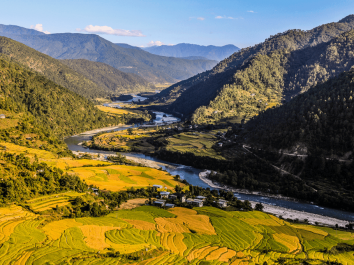
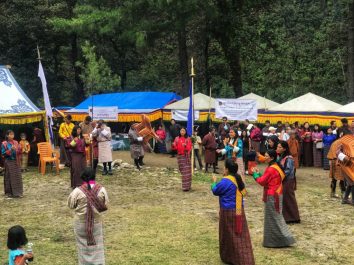
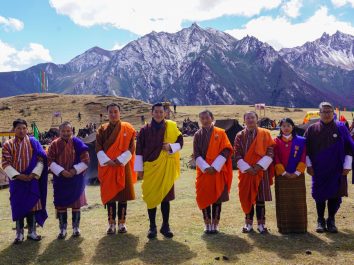
After centuries of isolation, Bhutan is now evolving into a modern era, consciously preserving its vibrant traditional culture and rich, almost pristine natural environment. As a result, Bhutan has earned the label of being one of her most authentic destinations on the world tourist map. The cultural spirit and religion embodied in dress codes, elaborate festivals, traditional sports, arts and other indigenous practices make Bhutan a truly unique destination, maintains a rich reservoir of flora and fauna and an impressive forest cover of almost 70%. It is one of the few countries in the world that pays more than lip service to protect the environment.
Gross National Happiness
The concept of Gross National Happiness (GNH) was promulgated by His Majesty Jigme Singye Wangchuck, the Fourth King of Bhutan in the early 1970s. When His Majesty spoke about GNH at the time, he questioned the prevailing measurement system that Gross Domestic Product (GDP) alone could deliver happiness and well-being to society. He was still a teenage monarch, and wise beyond his years. His Majesty firmly believed that happiness is an indicator, and a sign of progressive development for the Bhutanese people. He also believed in the legitimacy of public discussion in defining Bhutan’s development goals.
Political System in Bhutan
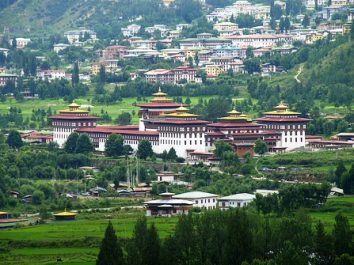
The Government of Bhutan has been a constitutional monarchy since 18 July 2008. The King of Bhutan is the head of state. The executive power is exercised by the Lhengye Zhungtshog, or council of ministers, headed by the Prime Minister. Legislative power is vested in the bicameral Parliament, both the upper house, National Council, and the lower house, National Assembly. A royal edict issued on April 22, 2007 lifted the previous ban on political parties in anticipation of the National Assembly elections in the following year.In 2008, Bhutan adopted its first modern Constitution, codifying the institutions of government and the legal framework for a democratic multi-party system.
Flora & Fauna
Bhutan is one of the last remaining biodiversity hotspots in the world, forest cover has now increased to over 72% of the country, with 60% of the country under protection.
Bhutan’s array of flora and fauna is unparalleled due to conservation and its wide altitudinal and climatic range. Physically, the country can be divided into three zones:
Alpine Zone (4000m and above) with no forest cover;
Temperate Zone (2000 to 4000m) with conifer or broadleaf forests;
Subtropical Zone (150m to 2000m) with Tropical or Subtropical vegetation.
Forest types in Bhutan are fir forests, mixed conifer forest, blue pine forest, chirpine forest, broadleaf mixed with conifer, upland hardwood forest, lowland hardwood forest, and tropical lowland forests. Almost 60% of the plant species found in the eastern Himalayan region are present in Bhutan.
Bhutan boasts of about 300 species of medicinal plants and about 46 species of rhododendrons. Some common sights for the visitors are the magnolias, junipers, orchids of varied hues, gentian, medicinal plants, Daphne, giant rhubarb, the blue and trees such as fir, pine and oaks.
Arts and Crafts (Zorig chusum) in Bhutan
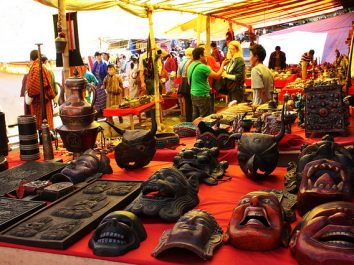
Bhutan is proud of its artistic heritage and produces works of excellent quality and great artistic value.
The arts and crafts are grouped in one list under the name “Thirteen Arts”, the Zorig Chusum: Zo means “to make””, rig “science” and chusum “thirteen”.
They consist of
Bamboo weaving (tsharzo)
Blacksmithy (Garzo)
Carpentry (shingzo)
Carving (parzo)
Embroidery (tshemzo)
Gold/Silver Smithy (trozo)
Masonry (dozo)
Painting (lhazo)
Paper-making (Shogzo)
Textiles (thagzo)
Sculpture (jimzo)
Casting (lugzo)
Calligraphy (yigzo)
The first seven arts were considered more prestigious because dealing directly with the religious aspects of life.
This list was probably codified at the end of the 17th century during the reign of the 4th Temporal Ruler (Desi), Tenzin Rabgye (1680-1694) and incorporate all the arts which were necessary to the religious and administrative life developed by the Zhabdrung Ngwang Namgyel (1594-1651). One of the most famous artists whose name has been kept is Penlop Dragpa Gyatsho (1646-1719) of Paro.