
The Magical Tiger's Nest
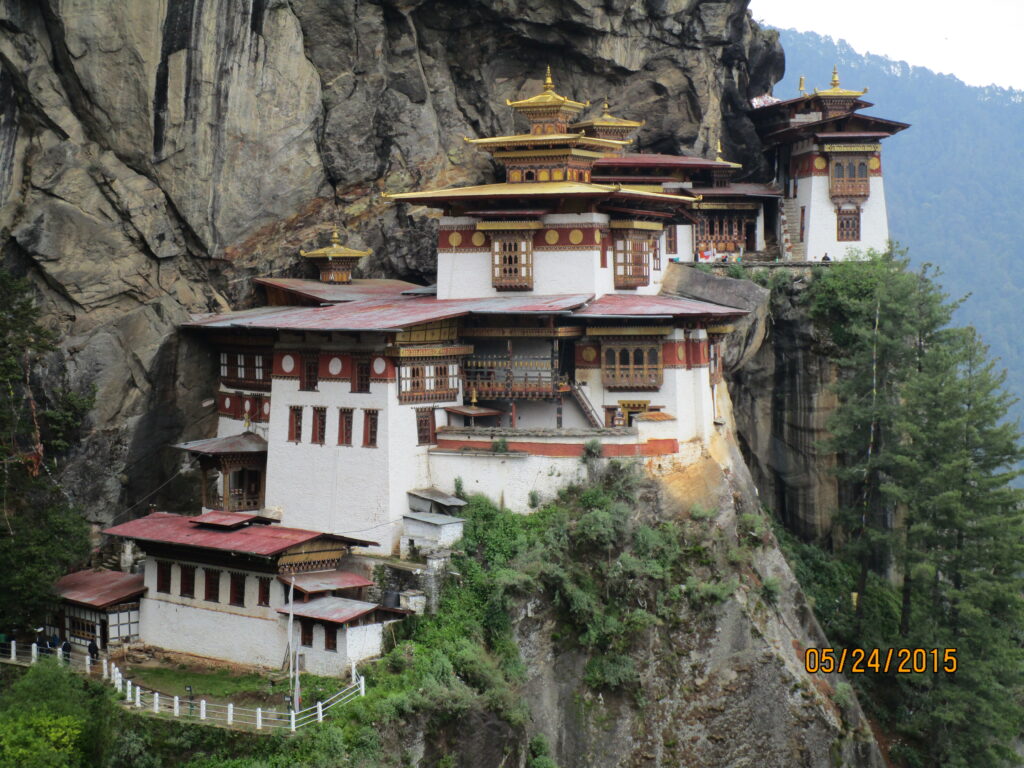
Guru Padmasambhava, the Abbot of Uddiyana, visited Bhutan in 8th century. He sanctified this monastery which evil spirits were said to frequent and bring much harm to the people. He assumed the tarrying form of Guru Dorje Drolo, one of his eight manifestations and blessed the Taktshang cliff as the holiest site. It made it one of Bhutan’s most sacred religious sites. After the Guru’s miraculous journey on the back of Yeshe Tsogyal whom he transformed into a flying tigress, he meditated there for four months.
In accordance with the prophecy of Guru Rinpoche, Khandro Yeshi Tshogyal, the consort of Guru Rinpoche, meditated at taktshang, transforming herself into a tigress to protect herself from harmful human and wild animals. People who happened to be in the in the vicinity of Taktshang in those days had seen a real tigress residing in the cave. The cave thus came to be known as “Taktshang” meaning “the Tigress’s lair”.

The image of the wrathful Guru Dorje Drolo mounting the tigress, as we witness it today, is the form of a tigress in our impure perception but in reality the tigrees is the form assumed by Kandro Yeshi Tshogyal.
The Tiger’s Nest hangs on a cliff above a forest of blue pine trees and rhododendrons at an altitude of 2950 meters (9678 ft) above sea level. The hike starts at the alleviation of 2600 m, the climb is about 800 m. After walking for one hour you will reach at cafeteria, where you can have toilet and tea break. Again walk for another one hour you will be at Taktshang temple. The views as we climbed were breath-taking; yellow rice fields far below, tiny buildings, prayer flags fluttering on poles among the trees. Paths undulated, mainly up with some down. The journey back was much easier, mainly downhill, but also steep upward stretches
Pelphug, Langchen Pelgi Sengye
While conferring initiation and empowerment of the Kagyad cycle to his twenty five twenty five chief disciples at Yamalung in Tibet. Guru Rinpoche instructed Langchen Pelgi Sengye to carry out the practice of Drag ngag Dregpa Kundue(the fierce mantras of taming all haughty spirits., at Taktshang Sengye Samdrup in Bhutan. Langchen Pelgyi Sengye was one of his chief disciples equal to the Guru himself in spiritual attainment.
Later, in accordance with the prophecy following in the footsteps of his master, Langchen Pelgi Sengye came to Taktshang in the year 853 A.D and meditaed upon the deity Dregpa Kundue for a prolong time at Taktshang through practice, he accomplished the duty gaining profound mantric power that power that enabled him to bind gods and spirits into servitude. The cave came to be known as “pelphug” ever since named after Langchen Pelgi Sengye. He went to Nepal where he died. His kudung(bone relic) was brought back to Taktshang by the protective deity Damchen Dorje Legpa(vajra sadhu) where after he concealed it deep in the cave as a hallowed treasure. Today his Kudung choeten stands in the hall at the top of the entrance stairway to the left.
Nine sacred caves at Taktshang
Machig Phug :
This is the cave where Machig Labdron, who was believed to the incarnation of Khandron Yeshi tshogyal, meditated. It is located above the raven where a beautiful waterfall can be seen. Today a lhakhang containing a statue of Machig Labdron in seen there. Her footprint and a drupchu can also be seen beside the lhakhang.
Sengye Phug
This cave is located near the stream that cascade through the ravine. It was here that Guru Rinpoche meditated on the Vajra kila, the deity of the magic dagger.
Pelphug
This is a cave where Guru Rinpoche meditated four months and visualized the deities of the magic dagger(phurba lhatshog). Today the purba is preserved here, which is particularly venerated. Lanchen Pelgi Sengye also meditated here in this cave where he gained mantric power that enabled him to bind gods and spirits into servitude.
Drole Phug
This cave is located beneath and a little further away from the lhakhang of Sengye Samdrup across the cliff towards Shama Lhakhang. It is shaped like Dorje Drolo.
Odsel Phug
The cave is said to be located in the lower left of the main monastic complex where self created Tshepamed ( the Amitayus Buddha, the lord of boundless life) and pasham shing (the wish fulfilling tree) are believed to be seen. The cave is so named because fortunate disciples could experience luminosity and realization.
Gedig Phug
This is believe to be the cave where separation of virtous and non virtous actions takes place. It is located on the way before reaching the bridge spanning the ravine between two outcrops of rock.
Chogyal Phug
Located a little beneath Gedig Phug, Cherezig the lord of compassion in the form of the lord of deathis believe to reside in this cave.
Kapali Phug
This is the cave where profound treasures of secret oral traditions which enable subjugationof demons and spirirs are available. It is said to be located somewhere near the Shama Lhakhang.